Mirrored Prescription Sunglasses: Style & UV Lens Basics
Summer always seems just around the corner, and that brings thoughts of beaches, sunshine, and, of course sunglasses. But if you also wear prescription glasses, trying to add non-prescription sunglasses on top may not be the most convenient approach.
This guide explains how mirrored prescription sunglasses pair vision enhancement with a reflective lens finish and a distinct look you can wear every day.
We will walk through how mirrored prescription sunglasses are made, common use scenarios, and features to consider so you can find a style and lens setup that fits your preferences.
Glare beware
Get polarized lenses with your prescription sunglasses
By the end, you will have a clearer sense of key lens features, coating options, and fit details to keep in mind while you shop for mirrored prescription sunglasses.
What Makes Mirrored Prescription Sunglasses Different?
Mirrored lenses start with a standard tinted sunglass lens. A thin reflective coating is then applied to the front surface, creating the familiar shiny look. This mirror finish reflects a portion of the incoming light before it reaches your eyes, which decreases the total amount of visible light passing through the lens.
In prescription form, your vision correction is incorporated into the lens along with the tint and mirror finish. This allows you to have lenses that are both tinted and reflective, while also including your prescription in a single pair.
It is also important to separate mirror style from UV labeling. A mirror finish can make lenses look darker, but ultraviolet (UV) labeling depends on the lens material and UV treatments, not on how reflective the surface appears.
Need sunglasses?
Protect those peepers from the sun’s harmful rays with 100% UV-blocking sunglasses
For many shoppers, that means focusing on three things: lenses that are labeled as filtering UVA and UVB, a tint level appropriate for your environment, and a mirror color that fits your personal style and wardrobe.
Key Features of Mirrored Prescription Sunglasses
Mirrored finishes change how lenses look from the outside and how much visible light passes through them. Because a mirror reflects additional light, the combination of tint and mirror may make bright settings appear different compared with a similar lens without a mirror coating.
From the outside, mirrored lenses can offer a degree of visual privacy. In many lighting conditions, people around you see more of the reflective surface and less of your eyes. Some wearers like this effect for outdoor activities or busy environments.
Many people also choose mirrored prescription sunglasses as one way to incorporate UV-filtering lenses into their routine. A mirror finish can be added to lenses that are labeled as filtering UVA/UVB, offering a particular aesthetic and light-transmission profile in addition to the underlying lens specifications.
Sunglasses have come a long way
We have endless shapes and colors to choose from
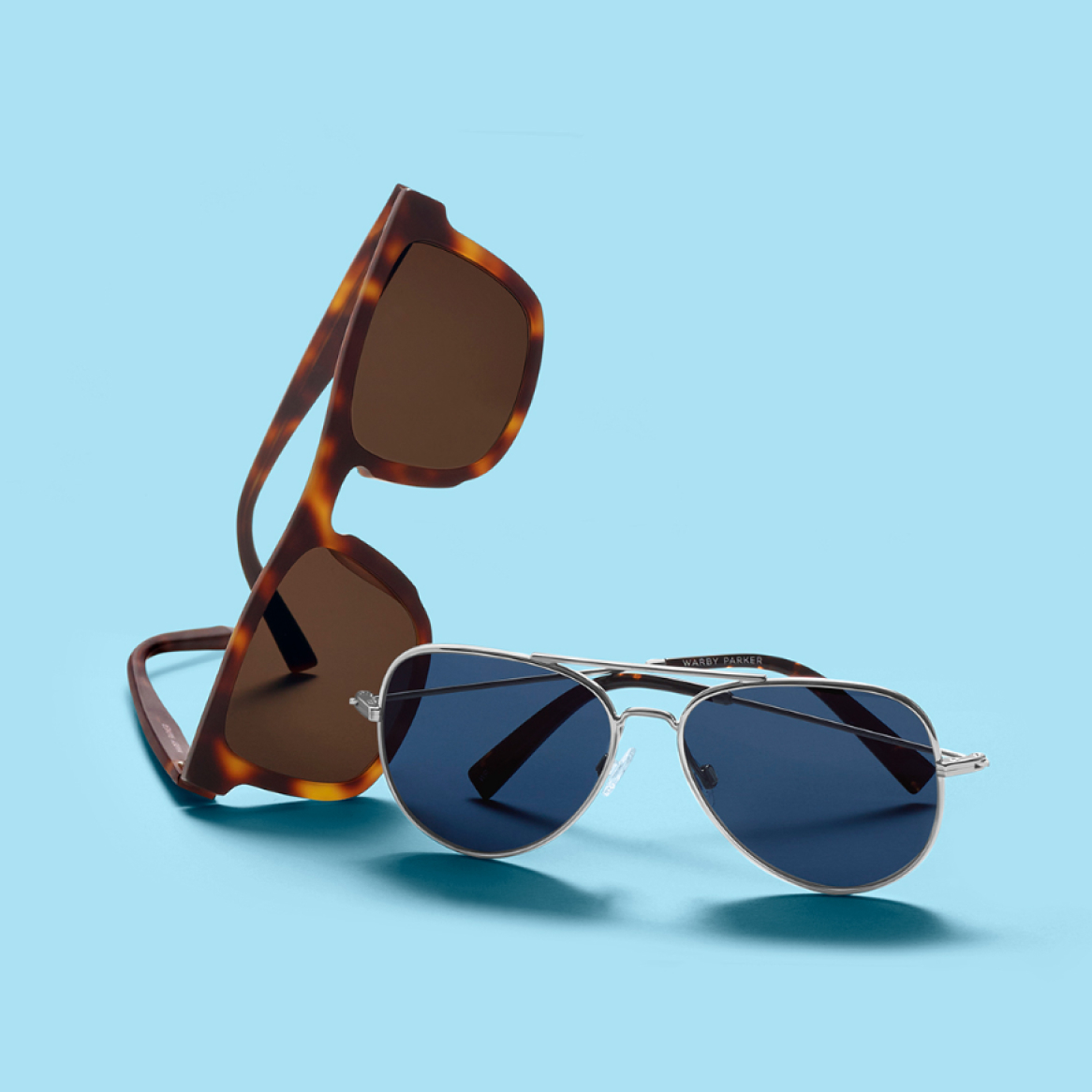
Mirror colors are available in a range of styles. Silver and gunmetal are often associated with a classic or sporty aesthetic; gold and rose tones can add warmth; blues and greens tend to read as more playful or modern. Because the underlying lens tint can be neutral (like gray) even when the mirror is colorful, you may see relatively natural-looking color through the lens while the exterior appears more bold.
- Light reduction: Mirror coatings can further decrease the amount of visible light passing through tinted lenses.
- UV filtering: Lens options include UV-filtering features, as indicated on product labeling.
- Visual privacy: A reflective surface can offer a sense of visual privacy.
- Color variety: A range of mirror colors is available to match different styles and wardrobes.
How to Choose the Right Mirrored Prescription Sunglasses
It can be useful to start by thinking about how and where you plan to wear your sunglasses. For example, someone who spends time driving in changing light (such as moving between open roads and shaded streets) may prefer a moderate tint that feels versatile across conditions. Someone who spends more time at the beach or on the water may gravitate toward a darker tint and a mirror finish in very bright environments.
Next, consider lens features beyond the mirror. Polarized lenses are designed to interact with reflected light in a specific way, and they are commonly selected for activities around roads and water. A mirror finish by itself does not create polarization, but some lens options combine polarization with a mirror coating for people who want both features in a single pair.
Frame fit is also an important part of the overall experience. You may want frames that match your face width, sit comfortably on your nose and ears, and provide coverage that aligns with how you plan to use them. Some people prefer slightly larger or more wrapped shapes, which may limit light entering from different angles compared with smaller, more open frames.
Protect those peepers
Our sunglasses provide 100% UV protection
Finally, it is a good idea to confirm a few basics: that your prescription details are accurately included in the order, that lenses are labeled as filtering UVA/UVB if that is important to you, and that any additional coatings (such as scratch resistant or easy-clean options) align with how you typically use and care for your glasses.
Final Thoughts on Mirrored Prescription Sunglasses
Mirrored prescription sunglasses combine a reflective finish, a tinted lens, and vision enhancement in one frame. This combination can change how bright conditions appear and offers a distinct look compared with non-mirrored lenses.
As you compare options, you may want to focus on whether the lenses are labeled as filtering UVA/UVB, the tint depth that matches your usual environments, and a mirror color that feels like your style. From there, you can think about other features – such as polarization, scratch-resistant coatings, and frame shape – to narrow down choices.
If you are ready to explore mirrored prescription sunglasses, you can browse available collections, compare lens packages, and use tools like virtual or in-store frame styling (if available) to see which shapes and colors you like. You can also share this guide with anyone considering mirrored lenses, or use it as a reference while you shop.
Looking to try '70s sunglasses?
Virtually find your perfect sunglasses anywhere, anytime
Legal Disclaimer
MEDICAL DISCLAIMER: This content is provided for educational and informational purposes only and is not intended as medical advice, diagnosis, or treatment. This information should not be used to replace professional medical care or consultation. Individual results may vary significantly. Always consult with a qualified healthcare provider before making any decisions about your health, vision, or medical treatment. Never disregard professional medical advice or delay seeking treatment because of information you have read on this website.
VISION CARE DISCLAIMER: Vision correction needs vary by individual. Consult an eye care professional for personalized assessment and recommendations.
FDA DISCLAIMER: These statements have not been evaluated by the Food and Drug Administration. This content is not intended to diagnose, treat, cure, or prevent any disease or medical condition.
PROFESSIONAL CONSULTATION REQUIRED: Only qualified eye care professionals can provide personalized recommendations for your specific vision needs and health conditions.
This article is for informational purposes only. It is not intended to provide medical advice or substitute for professional health services. Warby Parker complies with all HIPAA regulations regarding your health information. For personal health questions or concerns related to your vision or eyewear prescriptions, please consult a qualified healthcare provider.
Are mirrored prescription sunglasses different from regular sunglasses?
Mirrored prescription sunglasses include both a mirror coating and prescription lenses, whereas many regular sunglasses may be non-prescription or may not have a mirror finish. Some people prefer the appearance and light-transmission characteristics of mirrored lenses, while others prefer non-mirrored styles.
Do mirrored lenses provide UV filtering?
The mirror coating alone does not determine UV filtering. UV filtering is related to the lens material and any UV treatments. If UV-filtering features are important to you, look for product descriptions that state the lenses filter 99-100% of UVA and UVB.
Can I get my prescription in mirrored sunglasses?
Many common single-vision prescriptions can be made with a mirror finish. Very high prescriptions or more complex lens designs may have more limited frame and lens options, so it is helpful to review specific availability before you order.
What should I consider if I plan to wear mirrored prescription sunglasses while driving?
Some drivers prefer tints that are not extremely dark and that allow traffic signals and road signs to remain easy to see in varying light conditions. If you plan to wear mirrored prescription sunglasses while driving, you may want to look at tint depth, local guidelines on driving eyewear, and how the lenses perform in both bright and shaded areas.
Do mirrored lenses scratch easily?
Like other coated lenses, mirrored lenses can scratch if they are not handled and cleaned carefully. Lenses that include a durable hard coating and regular cleaning with a microfiber cloth and lens-appropriate cleaning solution may help keep the surface in good condition.
Need Glasses?
Shop prescription glasses starting at $95