Ordering glasses online is convenient – until you reach the box asking for your PD and realize you don’t know what that even means. PD means pupillary distance, which can sound technical, but you don’t necessarily need special equipment to get a basic measurement.
This guide explains what PD is, why it’s used when ordering glasses, and a general overview of how people often measure it at home. You’ll see commonly used methods and tips so you can better understand PD before ordering glasses online.
Your PD (pupillary distance) is the space in millimeters between your pupils. It’s one of several measurements used when making eyeglass lenses, because it tells the lab how far apart to place certain reference points in the lenses.
Below, you’ll find an overview of what PD is, tools that are typically used, a step‑by‑step method using a ruler and mirror, general accuracy tips, and situations where you may want to visit an eye‑care professional instead of relying on a DIY approach.
Understanding PD and How It’s Used
Pupillary distance (PD) tells the lab how far apart to position key reference points on your lenses. When PD is accounted for correctly, those reference points are more aligned with your eyes based on the measurement your provider or retailer uses.
If the PD used for your glasses differs from your actual PD, some people may notice that it feels harder to see through their lenses in certain positions. Resources like Cleveland Clinic explain what pupillary distance is, how it is typically measured, and how it may relate to your overall visual experience with your lenses.
There are two main ways PD is recorded: – Binocular PD is one number (for example, 63 mm) representing the distance from pupil to pupil. – Monocular PD breaks it into two numbers (for example, 31/32 mm), measuring from the center of your nose to each eye separately.
Monocular PD is often used when lenses have different viewing areas (such as progressives or bifocals), because it gives separate measurements for each eye.
Most adults fall within common PD ranges-often in the low‑60s in millimeters-but averages are just that: averages. They are not a substitute for your own measurement. Small differences between your eyes are common, which is why it’s important to use measurements that are specific to you rather than copying someone else’s numbers.
Understanding PD can also help you read your glasses order more confidently. Your sphere, cylinder, and axis values describe lens power, while PD is one of the fitting measurements that helps determine where that power is positioned in the lenses.
Step-by-Step: PD Measurement at Home
You don’t need specialized tools to get a basic PD measurement. Many people use a rigid millimeter ruler, a mirror, and good lighting. Check out several ways to measure pupillary distance at home, and the method below is a commonly described approach.
Method 1: Ruler and mirror (DIY)
Stand about 8–12 inches from a mirror. Hold the ruler flat against your forehead, with the zero mark above the center of one pupil. Keeping your head straight, look directly into your eyes in the mirror-don’t follow the ruler with your gaze. Read the number directly above the center of your other pupil. That is your binocular PD.
* Repeat the measurement at least 3 times and write down each result.
* If numbers vary, discard any outliers and average the rest.
* Ask a friend to measure you while you look at a distant point; this can sometimes make it easier to read the ruler.
Method 2: Getting monocular PD
To find each eye’s PD, start with the zero at the center of your nose. Looking at a distant point, have a helper mark where the ruler lines up with the center of your right pupil, then with your left. These two numbers (right and left) may add up to your binocular PD measurement.
Using Apps, Accuracy Tips, and When to See a Pro
Some people prefer to use smartphone‑based tools or apps for PD measurement at home and find that smartphone‑based pupillary distance measurements can be reasonably consistent under specific conditions, though they are not intended to replace measurements taken with professional instruments. Following each app’s instructions – such as how far to hold the phone and how to position any reference card – can make a difference in how consistent your readings are.
Whichever method you use, a few general tips can help you take more consistent measurements:
- Measure in bright, even light so you can clearly see your pupils.
- Keep your head and ruler or device as still as possible.
- When another person is measuring you, looking at something far away (instead of the ruler) may help keep your eyes in a more natural position.
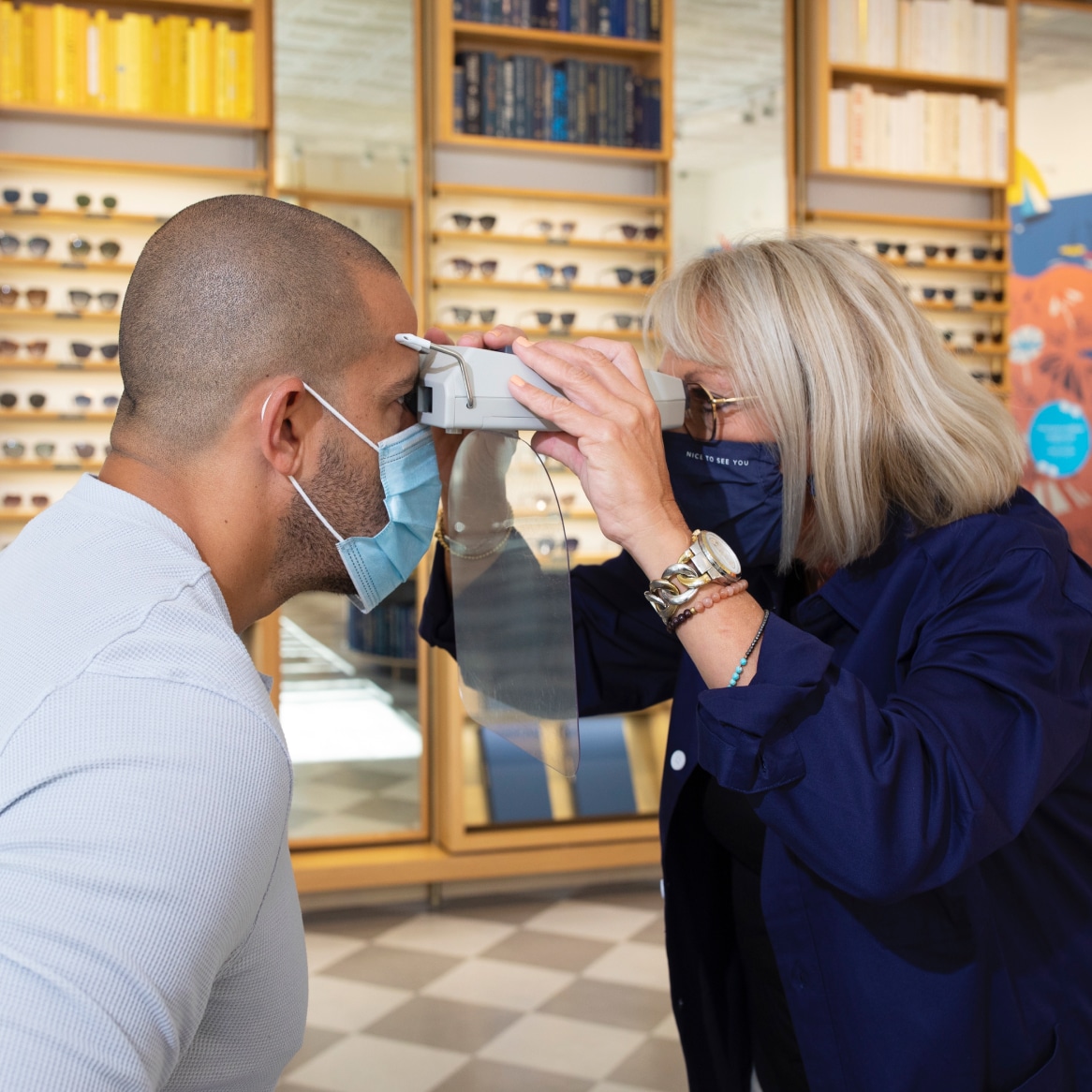
Some people choose to use DIY PD measurements when ordering many single‑vision lenses online. For more complex prescriptions, multifocal or progressive lenses, or anytime you prefer more precise measurements, consider visiting an eye‑care professional. They can use specialized tools and techniques to take PD and other fitting measurements.
If you ever notice that your new glasses feel off, or if you’re having trouble seeing clearly through them, reach out to an eye‑care professional. They can help check your prescription, PD, and overall fit.
Final Thoughts on PD Measurement at Home
With a ruler, mirror, or certain smartphone tools-and a few extra minutes for repeat checks-you may be able to record a PD measurement at home that some people use when ordering single‑vision glasses online.
If your home measurements vary a lot, your prescription is more complex, or you’re simply not comfortable relying on a DIY approach, an optician or optometrist can take your PD and other fitting measurements using professional tools.
Your glasses prescription and PD are just two of the measurements used to make your eyewear. Keeping track of this information and asking questions when something isn’t clear can make the process of ordering glasses feel more straightforward.
Frequently Asked Questions
What is a normal PD for adults?
Most adult PD measurements fall somewhere in the low‑60s in millimeters, but the range is wide and varies by face size and individual anatomy. Use measurements that are specific to you instead of relying only on averages.
How precise does PD measurement at home need to be?
The level of precision needed for PD can depend on factors like your prescription, lens type, and how sensitive you are to small changes in lens position. If you have questions about how precise your PD should be for a particular order, check with your eye‑care professional or eyewear provider.
Can I use an app instead of a ruler for PD?
Some people use smartphone apps or online tools to estimate their PD. If you choose this route, follow the instructions closely, take several readings, and compare the results. These tools are not a substitute for an in‑person fitting by an eye‑care professional.
Is PD the same as my prescription?
No. Your prescription describes lens power (for example, sphere, cylinder, and axis). PD is a separate fitting measurement that helps indicate where that power is positioned in front of your eyes.
Can I measure PD by myself, or do I need a friend?
You can attempt to measure your PD by yourself using a mirror and a ruler. Some people find that asking a friend to help-especially while they look at a distant point-makes it easier to read the measurement.
Do children need professional PD measurements?
Because children’s eyes and faces are still changing as they grow, it’s generally recommended that a professional measure their PD and handle fitting for their glasses.
*This article is for general informational purposes only and is not intended to provide medical advice, diagnosis, or treatment. It should not be used as a substitute for professional eye‑care or medical advice from a qualified provider who is familiar with your individual needs. Always talk with an optometrist, ophthalmologist, or other qualified eye‑care professional if you have questions about your vision, glasses prescription, or fitting measurements such as PD. If you are experiencing sudden changes in vision, eye pain, or any other concerning symptoms, contact a health‑care professional right away or call emergency services (such as 911 in the United States).*